Ecovon – A More Sustainable Wood Alternative Made from Coconut Husks
Ghanaian start-up Ecovon produces coconut-husk boards as an alternative to MDF (medium-density fibreboard), made without intentionally added toxic chemicals.
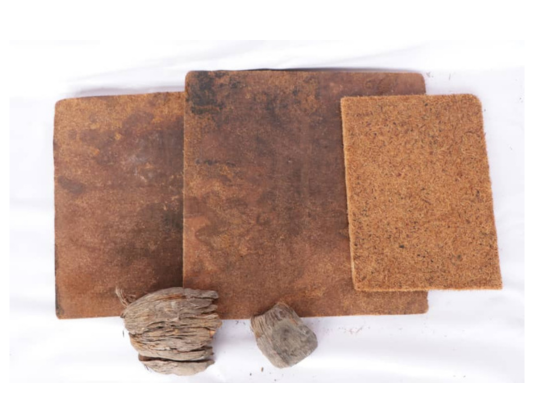
These boards can be used for furniture and interior panels, offering a more sustainable substitute for conventional wood-based materials. The company has developed a process that relies on the coconut husk’s natural bonding properties, eliminating the nd for toxic binders or harmful additives.
For these reasons, Ecovon received the “Best Regional Impact” award at the ISC3 Innovation Challenge 2019/2020 and is featured by the International Sustainable Chemistry Collaborative Centre as the ISC3 start-up of the Month for April 2026.
While being designed to be biodegradable at the end of their life cycle, the boards retain key performance characteristics such as density and durability. They have also demonstrated greater resistance to ignition and fire penetration compared to conventional boards. Additionally, they are naturally more resistant to rot than many other plant fibres. By replacing conventional MDF, Ecovon helps reduce deforestation, lower carbon emissions, and prevent indoor air pollution caused by synthetic resins. At the same time, the company supports forest- and agriculture-dependent livelihoods, creates new income streams for farmers, and generates local employment opportunities.
Ecovon advances a circular economy model that turns waste into value. Combining green chemistry principles with circular design, the company offers a climate-friendly and resource-efficient alternative to conventional MDF.
The whole success story of the ISC3 Start-up of the Month in April 2026 is currently told by the ISC3 on its website at Ecovon (isc3.org).

Three questions for Brenya Isaac (Co-founder & CEO of Ecovon):
What led to your solution in Sustainable Chemistry?
Brenya Isaac: The idea for Ecovon emerged from a personal experience. During my final year at university, I witnessed severe deforestation in southern Ghana driven by timber logging for conventional MDF production. Seeing how this was affecting forests, rainfall patterns, and local livelihoods pushed me to question whether building materials had to come at the expense of nature.
What does being chosen as ISC3 Start-up of the Month mean to you?
B. Isaac: Being chosen as the ISC3 Start-up of the Month is significant recognition for Ecovon. It validates our innovation and impact, and opens opportunities for catalytic funding, technical support, and global visibility. This will help us to scale up our production of binderless boards and reach more communities in a sustainable way.
What’s next up at Ecovon?
B. Isaac: Ecovon’s next steps are to transition from pilot production to our first commercial plant, enabling us to meet growing demand for our binderless boards. Alongside scaling up our operations, we plan to expand our market reach, strengthen our supply chains, and continue to improve the efficiency and sustainability of our production processes.
Company

International Sustainable Chemistry Collaborative Centre ISC3Friedrich-Ebert-Allee 32 + 36
53113 Bonn
Germany


most read
Merck Acquires Chromatography Business from JSR Life Sciences
Merck to acquire the chromatography business of JSR Life Sciences, a leading provider of CDMO services, preclinical and translational clinical research, and bioprocessing solutions.

Dow to Shut Down Three Upstream European Assets
Building on the April 2025 announcement, Dow will take actions across its three operating segments to support European profitability, resulting in the closure of sites in Germany and the UK.

CHEManager International Media Kit 2026
Compelling solutions through strategic partnerships
Novo Nordisk to Cut 9,000 Jobs Globally in Major Restructuring
Novo Nordisk announced a global workforce reduction of approximately 9,000 positions to streamline operations and reinvest DKK 8 billion (€1 billion) in growth opportunities for diabetes and obesity treatments.